
BY GWEN HAYES
Sentinel Editor
Tuesday’s weather with a bright sunshine and a frequent breeze provided the perfect atmosphere for the Friends of the Riverwalk, Inc. to present 6 new inductees for the Historical Monument Trail. Three of the 6 are of African-American descent.
Jack Harris served as Master of Ceremonies 3 p. m. event. Steve Anderson, Historical Monument Trail Committee Chair, introduced the volunteers and members of the Honoree Selection Committee.
City of Tampa Mayor Bob Buckhorn talked about the 5 mayors this project has gone through to come to fruition. He recognized the families that represented the honorees, while paying homage to the diversity of the 6 people selected. “This is what makes us different,” he said. “This is a great day for Tampa as we honor the forefathers of these families. We should never forget where we came from.”
The 2013 honorees are: Cyril (C.) Blythe Andrews (1901-1977), (pictured), remembered as a trailblazing newspaper man, businessman, philanthropist and civic leader.
He became secretary/treasurer of Central Life Insurance Co., a real estate developer and led the Grand Assembly of Lily White Security Benefit Association, Inc., which built 3 temples, the Lily White Hospital, the Lily White Rest Haven and created an ambulance service.
In 1945, he re-started the Florida Sentinel and bought the Tampa Bulletin in 1959, merging the two papers to become the Florida Sentinel-Bulletin. As a publisher, his endorsement was coveted by office seekers.
A Mason and an Elk, he served on numerous boards and committees.
Cody Fowler (1892-1978) came to Tampa in 1924 to practice law. His mother, Maud Fowler was one of the founders of Temple Terrace. He drafted the charter for Temple Terrace, served as its first attorney and first mayor.
Although it was unpopular, Fowler distinguished himself by defending African Americans in Tampa’s courts. In 1943 he joined with Morris White to form Fowler and White law firm.
In 1959, he was appointed chairman of Florida’s and Tampa’s Bi-Racial Commissions. His leadership along with African-American leaders helped guide the peaceful integration of Tampa’s lunch counters in 1960.
Kate Victoria Jackson (1857-1940) was born in Tampa to Irish immigrant parents. She founded and led the all-female Tampa Civic Association in 1910.
An astute businesswoman, philanthropist and environmentalist, Jackson was instrumental in establishing and funding the Academy of Holy Names; in starting and leading the nation’s second Girl Scouts of America troop; and in advocating and contributing to the purchase and preservation of the initial acreage for what became Everglades National Park.
Peter Oliphant Knight (1865-1946) was an influential member of Tampa’s business institutions. When he moved to Tampa in 1889, there were fewer than 1,000 residents. He served as a City Councilman, County Solicitor and was prominent in the development of Davis Island. Knight and others organized the Exchange National Bank, Tampa Gas Company and the City’s electric street car and lighting system.
He was the founding partner in what is today the national law firm of Holland & Knight.
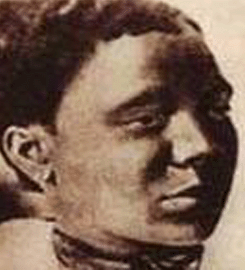
Paulina Pedroso
Paulina Pedrosa (1845-1925) was born and died in Cuba, but she was one of Tampa’s most influential Black women. She moved to Tampa in the 1880s and worked as a cigar maker. She and her husband, Ruberto, who was white worked to end racial segregation in Tampa. She led other Black Cubans in organizing La Sociedad Libres, or Society for Liberty. The Pedrosos returned to Cuba in 1910 and the Cuban government allowed them to live rent-free the rest of their lives. She died in 1923.
Pedroso was inducted into the Florida Women’s Hall of Fame in 1993.
Garfield Devoe (G. D.) Rogers (1885-1951 is said to have made his trek from Georgia to central Florida by walking along railroad tracks and selling railroad tires to buy food.
He worked as a tailor and dry cleaner in Bradenton and later obtained licenses in real estate and mortuary science. He and his wife opened Rogers Funeral Home.
In 1922, Rogers helped create Tampa’s Central Industrial (Life) Company, an agency that sold policies to Blacks. He also opened Rogers Hotel and Rogers Dining Room on Central Ave. Rogers invested in a beach resort for Blacks, established the Negro Business League and worked to register Black voters.
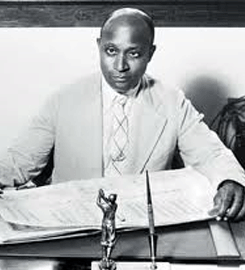
Garfield Devoe Rogers
Also known as a philanthropist, his most noteworthy gift was of land for a Tampa park to be used by Blacks. Today, that park which bears his name is the historical Rogers Park Golf Course.
The completed busts of each individual will be available for public viewing in December 2013.